

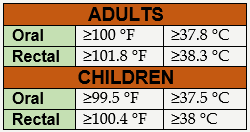
Note: Temperatures taken rectally are the most reliable when checking for a fever. Temperatures stated throughout the following information is based on rectal readings in Fahrenheit.
More information on taking a baby’s temperature can be found here.
Fevers
A fever, typically associated with the cold and flu, is one of the body’s natural defense mechanisms against undesired microorganisms, mucus, parasites, toxemia and venoms, and unwanted cells. Through a fever, the body can purge itself through the skin by raising body temperature and thereby increasing perspiration.
Other [often associated] symptoms of elimination include coughing, mucus discharge and diarrhea.
Fevers aren't a process you should attempt to stop. Rather, a fever should be monitored and kept under control while it runs its course.
Antipyretic (and liver-damaging) medications like Tylenol and Ibuprofen should only ever be used as an absolute last resort if a fever spikes too high for a prolonged period of time. But in most cases, this never happens. However, should a fever creep up too high, such situations can often be alleviated through natural means such as:
- using herbs with refrigerant and diaphoretic properties
- homeopathic remedies
- keeping the body hydrated and cooled down with baths and cold applications on back of neck or forehead
The key to fevers is to stay hydrated and not panic. Babies and children should always be under supervision and cared for during this process.
Adults – What to Do
Unlike babies and children, adults tend to stay below 104 °F. Fevers reaching ≥103 °F in adults should be controlled through cool baths and washcloths. Remember to stay hydrated and resort to diaphoretic herbs, if needed, following the instructions outlined below using Elderflower and/or Catnip leaf/flower.
Make a standard herbal infusion of the aforementioned herbs:
- Measure 1 ounce of Elderflowers OR Catnip leaves/flowers (or ½ ounce of each herb, if mixed together)
- Put plant material into a sealable 32 oz. (1 liter) mason/preserving jar preferably made of glass
- Pour 32 oz./1 liter of boiling water into the jar, stir the contents, then cap and seal the jar
- Allow plant material to steep for 1 hour before consuming
Drink 4 cups (totaling 32 oz.) of the infusion throughout the day (or as needed); infusion should be consumed within 36 hours.
Infants/Children – What to do
It's very common for infants (3-12 months) and toddlers (1-4 years) to hit 104-105 °F; this shouldn't be cause for concern. However, with newborns (meaning younger than 3 months), the temperature shouldn't exceed 100 °F.
- Make sure to keep the child hydrated, preferably with fresh coconut water (not canned) (coconut water is considered excellent for replacing lost electrolytes from sweating) or fresh-pressed and diluted grape juice.
- Keep the child cooled down with baths, soaked washcloths on the forehead or a cold application on the back of the neck.
- If needed, use refrigerant and diaphoretic herbs such as Elderflower or Catnip leaf/flower (both Elder and Catnip can be combined for best results; Catnip, like coconut water, will also help replace lost electrolytes) to lower body temperature (herbal infusions are excellent for this).
Instructions:
- Measure 7 grams (roughly quarter of an ounce) of Elderflowers or Catnip leaves/flowers (or 3.5 grams of each herb)
- Put plant material into a sealable 8 oz. (236 ml.) mason/preserving jar preferably made of glass
- Pour 8 oz./236 ml. of boiling water into the jar, stir the contents, then cap and seal the jar
- Allow plant material to steep for 1 hour
- After 1 hour, pour some into a small drinking bottle (for infants and toddlers) or just pour into a cup for children
- Note: For newborns, infants and toddlers, you can also soak a clean cloth in the herbal infusion and let the child suck on it.
- Note: To enhance the taste of the Elderflower infusion one can add peppermint (makes taste more pleasant) and/or rose hips (adds sweetness to the infusion).
- Note: The infusion can also be added to a bathtub/baby bathing tub that the baby can be held/sat in allowing their body to soak in the infusion through the pores. If using infusion for bathtub, consider making a standard infusion of 1 ounce of plant material to 32 oz. of water (using a quart jar instead, basically quadrupling the above recipe). Use the infusion within 36 hours.
Internal usage: 1 tablespoon of infusion 3 times a day for infants and toddlers. Older kids can drink half a cup (4 oz.) 2-3 times daily.
Using tinctured Elderflower or Catnip, use roughly 1 drop of tincture for every pound of body weight.
IMPORTANT NOTE
If you’re new to Dr. Morse and the dietary recommendations put forth in his educational material, please understand that Dr. Morse doesn't ever recommend the consumption of any dairy products (or commercial baby formulas), and especially so for children, as these are the very foods that contribute largely to all the common issues infants and toddlers often have, including:
- fevers
- vomiting
- diarrhea
- symptoms of colic (gas and GI-tract distress, etc.)
- earache
- mucus problems
- pink eye/conjunctivitis
Grains (non-sprouted in particular) are also considered acidifying, non-nutritive and damaging to the body and also contribute to the above health problems in children. In light of this, common “baby’s first food” items such as infant rice cereal and oatmeal aren't recommended.
You may consider some of the following better food choices for weaned babies and children. Fresh and homemade is preferred where applicable:
- Coconut water (young coconuts)
- Coconut milk (example here)
- Hemp milk (example here)
- Fruit juices (e.g. orange juice, grape juice, apple juice, etc.) (dilution is recommended)
- Fruit smoothies
- Pear purée (excellent first baby food)
- Green juice
- Mashed berries or berry purée (example here)
- Quality super food blends and/or small amounts of moringa oleifera
Homeopathic Remedies:
Homeopathic remedies can also be used.